Materials
Which outdoor furniture materials last in Australian conditions
Teak is durability Class 1 above ground, over 40 years. Jarrah and western red cedar are Class 2, 15 to 40 years. What those classes do and do not cover.
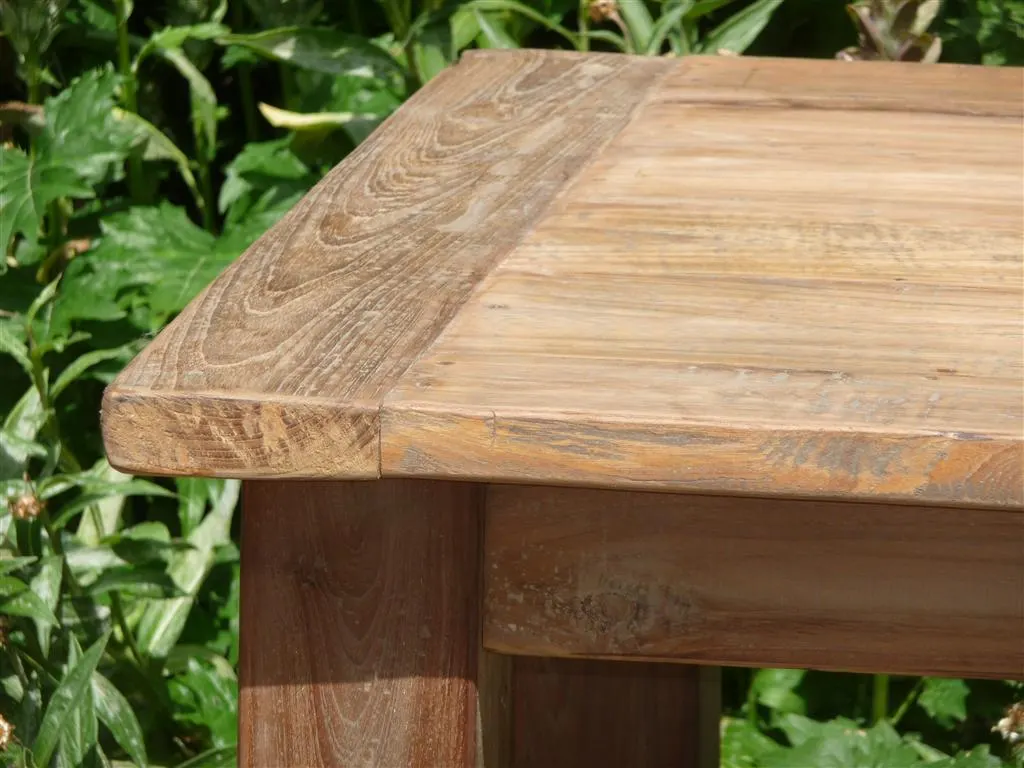
Outdoor furniture fails in three different ways, and the marketing word for all of them is 'weathering'. Timber can decay, finishes can break down under ultraviolet light, and metal frames can corrode where salt reaches them. Only the first of those has a published Australian classification.
This guide uses the Queensland Government's published timber property figures for three species commonly sold as outdoor furniture, then sets out what those classes leave unanswered. Prices in the guide are examples checked on 2026-11-03, not quotes.
Advertisement
What a natural durability class actually means
The Queensland Government publishes natural durability classes for construction timbers, with above-ground classes running from Class 1, a life expectancy of more than 40 years, through Class 2 at 15 to 40 years, Class 3 at 7 to 15 years, and Class 4 at under 7 years. The same species is usually given a separate, lower class for in-ground use.
The class describes the heartwood's resistance to decay and insect attack. It does not describe how the surface looks after a summer, how the joints behave when the timber moves, or how long a factory finish lasts. A Class 1 timber with poor joinery and uncoated steel fixings still falls apart, and it falls apart at the joints.
That distinction matters when a retailer quotes a durability class as though it were a warranty. The class is a property of the timber, and the furniture is a property of whoever built it.
| Timber | Above ground | In ground | Density at 12% moisture |
|---|---|---|---|
| Teak | Class 1, more than 40 years | Class 2, 15 to 25 years | 670 kg per cubic metre |
| Jarrah | Class 2, 15 to 40 years | Class 2, 15 to 25 years | 835 kg per cubic metre |
| Western red cedar | Class 2, 15 to 40 years | Class 2, 15 to 25 years | 380 kg per cubic metre |
Figures as published by the Queensland Government's timber properties pages, checked on 2026-11-03. Density matters for furniture because it is why a jarrah setting is hard to move and a cedar one blows over.
Greying is not decay, and the choice between them is yours
A teak or jarrah setting left unoiled turns silver-grey within one or two Australian summers. That layer is surface oxidation on the outermost fraction of a millimetre, and on a Class 1 timber it has no bearing on the 40-year figure. Many households find it attractive and simply stop oiling.
Oiling is therefore a cosmetic decision for a durable hardwood and a protective one for a less durable timber. For the Class 2 species in the table, and for any softwood, a coating is doing real work by slowing moisture cycling, which is what opens checks along the grain.
The cost of that decision is in the cost-per-year guide on this site: oil runs about $45 a year. On a Class 1 timber that $45 is buying a colour. On softwood it is buying years.
- Grey surface on teak or jarrah: oxidation, not decay, and reversible with a clean and an oil
- Splits along the grain at the ends of boards: moisture cycling, worth slowing with a coating
- Soft, crumbling timber at a joint: decay, usually where water sat against untreated end grain
- Rust streaks running down from a screw: the fixing failed before the timber did
- Loose joints after a few seasons: movement, which no durability class describes
Metal frames, powder coating and salt
Powder-coated aluminium does not rust, which is why it dominates coastal sales, but the coating is the only thing standing between salt-laden air and the metal underneath. A chip from a dropped tool or a dragged chair leg is where corrosion starts, and on an unprotected cut edge it spreads under the coating rather than across it.
Steel frames, including most outdoor wicker, rely entirely on their coating. Where a weld was ground after coating, or where a leg glide has worn through, the frame is exposed. Those are the first places to look on a second-hand setting and the first places to touch up on a new one.
Standards Australia develops the Australian and joint standards that cover coatings and corrosion testing, and sells them through its store and subscriptions rather than publishing them free, offering a public access reader room for limited free reading. That means the test a manufacturer cites is usually verifiable only by buying the standard, so treat a bare standard number in marketing as a claim rather than a result.
| Material | First failure | Where to look | What slows it |
|---|---|---|---|
| Teak or jarrah | Joints, not boards | End grain and bolt holes | Keeping water off end grain |
| Western red cedar | Surface checking | Board ends and edges | An annual coating |
| Powder-coated aluminium | Coating chips | Feet, leg ends, welds | Glides and touch-up paint |
| Steel-framed wicker | Rust under the coating | Welds and worn glides | Storing under cover |
| Synthetic wicker weave | Ultraviolet embrittlement | Sun-facing surfaces | Shade over the setting |
Matching the material to the site
Three site facts settle the material more reliably than any preference. Is the setting under cover for most of the day, is it within a few hundred metres of surf, and will anyone realistically oil it once a year. Answer those and most of the options drop away.
A covered verandah inland is the easy case, where any of the three timbers reaches the upper half of its published range and even softwood performs acceptably. An uncovered deck near the coast is the hard one: salt reaches the metal, ultraviolet reaches the synthetics, and the timber that survives is the dense, high-class heartwood with stainless fixings.
If you want the simplest rule that holds: buy the Class 1 timber or the powder-coated aluminium for exposed sites, buy anything for covered ones, and spend the difference on shade.
- Decide whether the setting will be covered for most of the day
- Check how close the site is to surf or an estuary
- Decide honestly whether anyone will oil timber once a year
- Pick the Class 1 timber or powder-coated aluminium for exposed coastal sites
- Confirm the fixings are stainless rather than coated steel
- Budget shade before upgrading the material a step
Before you buy
- Read the above-ground durability class, not just the species name
- Check the in-ground class separately for any post set into soil
- Inspect end grain, bolt holes and welds rather than the board faces
- Confirm the fixings are stainless if the site is within reach of salt air
- Decide whether oiling is cosmetic or protective for the timber you chose
- Treat a standard number quoted in marketing as a claim until you have read the standard
Questions readers ask
- Is teak worth the premium over jarrah?
- On the published figures teak is Class 1 above ground, more than 40 years, and jarrah is Class 2 at 15 to 40 years. For a covered verandah both will outlast the cushions and the household's taste. For an exposed coastal deck the gap between those classes is the clearest reason to pay more, and jarrah at 835 kg per cubic metre is also far harder to move.
- Why is western red cedar used outdoors if it is only Class 2?
- Because of mass. At 380 kg per cubic metre it is less than half the density of jarrah, which makes large pieces liftable by one person. Its above-ground class of 15 to 40 years is the same as jarrah's, and it is listed for both indoor and outdoor furniture, but it dents easily and needs the annual coating that jarrah can skip.
- Does an in-ground class matter for furniture?
- Only for pergola posts and anything set into soil or a planter. All three timbers here drop to Class 2 at 15 to 25 years in ground, including teak, which is Class 1 above ground. If you are specifying posts for a shade structure, the in-ground column is the one to read.
- Can I restore a grey teak setting?
- Yes. The grey is oxidation on the outermost fraction of a millimetre. A wash, a light sand and an oil return the colour, and the process takes most of an afternoon with about $45 of oil. On a Class 1 timber this is entirely cosmetic, so doing nothing is also a defensible choice.
- Are stainless fixings worth it?
- On anything near salt air, yes, because the fixing is the first failure in the table above. Rust streaks running down from a screw head tell you the fixing went before the timber, and replacing corroded bolts in a hardwood frame is far more work than specifying stainless at purchase.
Sources
- Queensland Government — Teak: natural durability Class 1 above ground, Class 2 in ground, 670 kg per cubic metre — checked 2026-11-03
- Queensland Government — Jarrah: natural durability Class 2 above ground, 835 kg per cubic metre, listed for outdoor furniture — checked 2026-11-03
- Queensland Government — Western red cedar: natural durability Class 2 above ground, 380 kg per cubic metre — checked 2026-11-03
- Standards Australia — how Australian Standards are purchased, subscribed to or read in the public access reader room — checked 2026-11-03
Some links on this site can earn us a commission. That does not change which product a guide recommends, and it adds nothing to your price.